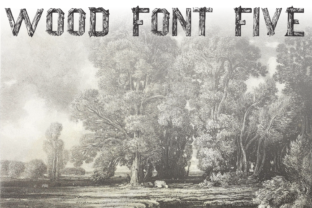
Wood Font Five: A Display Font with Natural Character
Every now and then a typeface comes along that feels less like a design tool and more like a material. Wood Font Five is exactly that kind of font. It brings the texture, warmth, and honest character of wood into your letterforms without trying to be a novelty or a gimmick. If you have ever needed a display font that says natural without shouting it, this one deserves a close look.
Wood Font Five belongs to the category of display and decorative fonts, which means it is designed to grab attention at larger sizes rather than carry long passages of body text. But within that category, it finds a surprisingly broad sweet spot. It works for branding, packaging, signage, social media, and editorial design where the subject matter leans toward nature, environmentalism, sustainability, or any project that benefits from a grounded, organic feel.
What Makes Wood Font Five Stand Out
The first thing you notice is the texture. The letters carry a subtle grain that never overwhelms the shape. It feels like carved wood, not like a filter slapped onto a generic sans serif. That restraint is important. A lot of nature-themed fonts go too far and end up looking like a rustic theme park sign. Wood Font Five avoids that trap. It keeps the forms clean enough for modern typography while retaining just enough organic detail to communicate its material inspiration.
The weight and proportion give it a sturdy presence. This is not an overly delicate font. The strokes have substance, and the letterforms sit solidly on the baseline. That stability makes it suitable for logo design and brand identity where you need the typeface to anchor a composition. It also means the font holds up well when scaled down to medium sizes for headlines or subheadings, as long as the surrounding layout gives it space to breathe.
Another detail worth noting is the consistency across characters. The grain pattern, the serif treatment, and the overall stroke contrast feel unified. That kind of polish is what separates a premium font from a freebie. When you use Wood Font Five across a website, a brochure, and a set of social media graphics, the visual identity stays cohesive. That matters more than most designers give it credit for.
Where Wood Font Five Delivers Real Value
Let me walk through the projects where this font genuinely shines. I have seen it used in four main areas, and each one plays to its strengths differently.
Branding for Nature-Focused Businesses
If you are building a brand around organic products, outdoor gear, sustainable goods, or environmental services, Wood Font Five immediately communicates your values. It works especially well for small-batch food producers, craft breweries, woodworkers, landscape designers, and eco-conscious apparel brands. The font adds texture and warmth to a logo without making it feel dated. It pairs naturally with a clean sans serif font for secondary text, which gives you that nice contrast between handcrafted character and modern readability.
Packaging and Labels
Packaging design is where Wood Font Five really earns its place. On a box, a jar, or a bag, the wood texture in the letterforms connects directly to the physical product. It signals authenticity. For example, a honey jar label using Wood Font Five for the brand name alongside a subtle handwritten font for the flavor description creates a layered, artisanal look. The same approach works for soap, candles, tea, and spice blends. The font brings a tactile quality to flat surfaces, and that translates well in product photography and e-commerce listings.
Editorial and Print Design
In magazines, brochures, and book covers, Wood Font Five works best as a title or chapter heading font. Its personality adds warmth to editorial projects about travel, nature, permaculture, sustainable living, or outdoor recreation. I have seen it used effectively in a printed field guide about tree identification, where the font choice reinforced the subject matter without being distracting. The contrast between the textured display font and a clean serif font for body copy creates a clear visual hierarchy that guides the reader naturally from headline to paragraph.
Digital and Social Media Graphics
On screens, Wood Font Five holds up well at headline sizes. It works in website headers, landing page hero sections, and Instagram or Pinterest graphics where you want to stop the scroll. The key is to give it plenty of padding and avoid placing it on busy backgrounds. A simple solid color block or a subtle gradient lets the wood texture read clearly. For social media, pairing it with a light sans serif font for captions keeps the feed balanced and professional.
How Wood Font Five Shapes Perception and Engagement
Typography is never neutral. Every typeface carries emotional and associative weight. Wood Font Five leans into associations of craftsmanship, durability, and connection to the natural world. When you use it, you are telling your audience something about your values before they read a single word. That subconscious messaging is powerful.
In terms of visual hierarchy, a display font like this one automatically draws the eye. It becomes the anchor of your layout. That means you need to use it deliberately. Reserve it for the most important elements of your design—the brand name, the main headline, the call to action. Let simpler typefaces handle the supporting roles. That contrast is what makes a layout feel intentional and professional.
Readability at display sizes is excellent. The letterforms are distinct, and the wood texture does not interfere with legibility. That might sound like a low bar, but you would be surprised how many decorative fonts sacrifice clarity for character. Wood Font Five does not make that tradeoff. You can use it confidently at sizes from around 36 points up to 120 points or more, depending on the medium.
From a brand identity perspective, consistency across applications matters. A font that works on a printed brochure and a mobile screen without losing its personality saves you time and headaches. Wood Font Five delivers that reliability. When you invest in a commercial font like this one, you are buying more than just letter shapes. You are buying a consistent visual voice that your audience will start to recognize over time.
Practical Guidance for Choosing and Using Wood Font Five
Deciding whether a display font fits your project comes down to two questions: does the personality match the message, and does it work with your other design assets? Let me give you a practical way to evaluate both.
Start with a simple test. Write your brand name or your main headline in Wood Font Five at the size you plan to use it. Then put it next to a mockup of your secondary typeface. Step back and ask yourself whether they feel like they belong in the same family of materials. If your secondary font is a cold, geometric sans serif, the contrast might feel jarring. If it is a warm, humanist sans or a traditional serif, the pairing will feel natural. Some pairings that work well include Wood Font Five with a clean sans serif like Open Sans, Lato, or Montserrat for digital projects, or with a classic serif like Crimson Text or Playfair Display for editorial work.
Next, check the included styles. Many display fonts come with only one weight, and that is fine for Wood Font Five because it is designed as a hero typeface. But if your project requires multiple weights for hierarchy, you may need to plan your layout around that limitation. Use the display font for the dominant element and rely on your secondary font for subheadings and body text.
Readability considerations are straightforward. Avoid using Wood Font Five for long paragraphs or small text. The decorative details that make it beautiful at large sizes become distracting when the letters shrink. Below 24 points, you risk losing the texture and the readability. Keep it for headlines, titles, logos, and short callouts where it can do its job without overstaying its welcome.
Commercial licensing is an important practical step. Wood Font Five is typically sold as a premium font, which means you need to check the license terms for your specific use. If you are using it for a client project, a product label, or a commercial website, make sure you have the right license. Most foundries offer standard desktop licenses for print and static images, and extended licenses for web embedding, apps, or merchandise. Read the terms carefully. It is a small investment that protects you and the designer who created the font.
If you are evaluating Wood Font Five for a project, I recommend downloading the trial version first and testing it in your actual layout. Mock it up in context. A font that looks good in a specimen sheet can feel different inside a full design. Test it at various sizes, on different backgrounds, and alongside your other design assets. That hands-on evaluation is the only way to know if it is the right fit.
Wood Font Five is not a font for every project. But for the right project—one that needs warmth, natural character, and a touch of craftsmanship—it is a genuinely useful addition to your design toolkit. It brings material honesty to digital and print work, and that is harder to find than you might think.