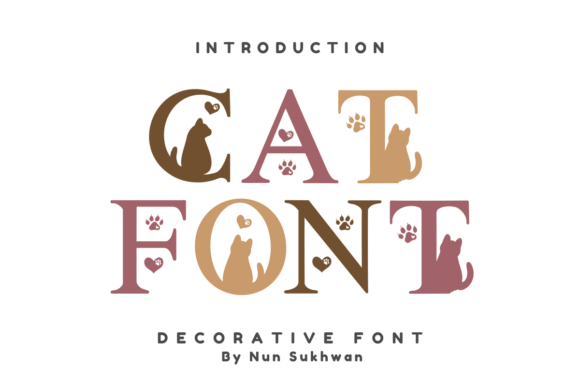
Cat Font: Practical Uses for a Distinctive Display Font
You've probably scrolled past dozens of fonts today without giving them a second thought. That's exactly what you don't want when you're building something that needs to stand out. Cat Font is designed to stop the scroll. It's a handwritten display font that brings a distinct feline-inspired personality to your projects—but calling it just a "novelty font" undersells its potential. When used strategically, it functions as a powerful visual anchor for everything from brand identities to casual social media graphics.
Visual Characteristics and Real-World Personality
At first glance, Cat Font feels familiar—it carries the warmth and irregularity of a hand-drawn script. Look closer, and the thoughtful details emerge: the upward flick on the terminal of a lowercase "t" mimics a twitching tail, the rounded bowl of the "e" feels approachable rather than sharp, and the overall weight variation gives the lettering a tactile, almost ink-on-paper quality. This isn't a typeface that tries to be invisible. It has texture, a slightly uneven baseline, and a distinctly human touch that aligns with modern typography trends favoring authenticity over sterile perfection.
As a handwritten font, it sits comfortably in the display font category. It's not designed for dense body copy, and it shouldn't be. Its superpower is emotional resonance. The curves and swashes communicate playfulness, creativity, and warmth. For a creative font, it strikes a rare balance: it's expressive enough to feel bespoke, but structured enough to remain legible when applied thoughtfully across different media.
Where Cat Font Makes the Biggest Impact
The best applications for Cat Font are those where you need an immediate emotional hook without overwhelming the viewer. Here's where it earns its keep across different disciplines:
Branding and Logo Design
For small businesses and entrepreneurs, establishing a memorable brand identity often comes down to differentiating from the sea of minimalist, generic logos. Cat Font works exceptionally well for boutique pet accessories, artisan bakeries, children's book authors, yarn shops, and natural skincare lines. Imagine a small soap business using Cat Font for the product name—"Lavender Dreams" on a kraft paper label instantly signals "handmade" and "natural." Pairing it with a clean sans serif font for the ingredients list maintains professionalism while keeping the brand voice warm and accessible.
Digital Media and Social Graphics
In the fast-paced world of social feeds, web design assets need to communicate a vibe in under a second. Cat Font shines as a hero element in Instagram story titles, YouTube thumbnail headers, and blog post pull quotes. Because it carries so much character, it creates instant visual hierarchy. A single word set in Cat Font draws the eye faster than any standard sans-serif ever could. I've seen it used effectively by lifestyle bloggers for "weekly roundup" headers and by small publishers for e-book cover titles.
Packaging and Print Projects
When you move into physical products, the tactile nature of Cat Font becomes a strategic asset. On mugs, T-shirts, tote bags, and greeting cards, the handwritten quality feels personal. It looks like someone took the time to write on the product, rather than mass-producing a sterile label. For packaging design, using it as an accent typeface—perhaps for a product story on the back of a box or the tagline on a hang tag—adds a layer of craftsmanship that consumers notice.
Readability, Hierarchy, and Brand Perception
Typography is a shortcut to emotion. A sharp corporate sans-serif says "efficiency." A delicate serif font says "tradition." Cat Font, with its whimsical curves, immediately says "approachable" and "creative." This makes it a potent tool for shaping brand perception.
The key to maintaining readability is restraint. Because the font has such a strong personality, using it for long stretches of text will strain the reader and dilute its impact. Instead, deploy it for headlines, call-to-action buttons, short product names, or accent quotes. This creates a clear visual hierarchy where the most important elements naturally stand out. A reader should scan a page and immediately understand what matters most—Cat Font helps you control that journey.
Consistency is equally critical for audience engagement and long-term recognition. If you consistently use Cat Font for your Instagram story titles or blog section headers, your audience will subconsciously associate that distinctive warmth and "wobble" with your specific brand voice. Over time, the font becomes a design asset that functions as visual shorthand for your business.
How to Evaluate Cat Font for Your Project
Before embedding Cat Font into your workflow, walk through this practical assessment to ensure it fits your goals:
- Project Fit: Is the context casual or formal? Cat Font thrives in informal, creative, and youth-oriented environments. A financial newsletter? Hard pass. A creative agency's internal holiday campaign or a pet rescue nonprofit's website? Perfect alignment.
- Scale Testing: This is a display font by nature. Test it at 24pt and above for its best performance. I generally avoid using Cat Font for body text smaller than 18pt, as the decorative terminals and uneven baseline can hinder quick reading.
- Font Family Depth: Does your version include multiple weights or stylistic alternates? Having a regular and bold variant gives you flexibility without introducing a conflicting typeface. A bold weight is invaluable for maintaining legibility on mobile screens or small social media ads.
- Mockup Verification: Never judge a font in isolation. Load Cat Font into a mockup tool. See how it looks at 72px on a desktop hero banner and at 16px on a mobile viewport. A font that looks charming on a poster can lose its impact on an Instagram story if the tracking isn't adjusted.
Making It Work: Pairing and Licensing
No premium font works in a vacuum, and Cat Font is no exception. To build a cohesive font pairing, you need a neutral counterpart that supports without competing:
- With a Sans-Serif: Pair Cat Font with a clean, neutral sans-serif like Open Sans, Lato, or Montserrat. The simplicity of these faces provides a stable foundation for the headline text, allowing Cat Font to act as the accent piece.
- With a Serif: For a more editorial or sophisticated feel, pair it with a subtle serif font such as Playfair Display or Garamond. The contrast between a traditional serif body and a playful handwritten headline creates visual tension that feels curated and intentional.
- With a Script: Avoid pairing Cat Font with another script font. Two competing handwritten styles typically clash and create visual noise. Stick to one expressive face per project.
On the business side, commercial font licensing is non-negotiable. If you are a designer using Cat Font for a client's logo, a small business owner printing it on merchandise, or a publisher embedding it in a digital product, you must review the specific license terms. Many commercial fonts require an extended license for logo use or print-on-demand services. Verifying this upfront protects your work and your client's assets down the line.
Common Pitfalls to Avoid
Because Cat Font is undeniably fun, the most common mistake is overusing it. I've seen projects where the font is applied to every single text element—headline, subheader, body, footer. This typically results in visual fatigue and often compromises readability. Treat it like an accent color or a specialty ingredient. A little goes a long way.
Another frequent issue is neglecting manual kerning. Handwritten display fonts often have uneven spacing between specific letter pairs that works perfectly at large sizes but can look disjointed in shorter strings like logos. Always adjust the tracking and kerning manually in your design software when using Cat Font for primary logo lockups or short headlines. That extra two minutes of polish separates an amateur implementation from a professional one.
Ultimately, Cat Font is a tool for injecting authentic personality into your work. By respecting its strengths—headlines, logos, accents—and building a supporting cast of neutral typefaces, you can create designs that feel both professional and genuinely expressive. Whether you're designing a mug, a landing page, or a brand identity, the strategic use of a creative font like this one ensures your message lands with the warmth and clarity it deserves.