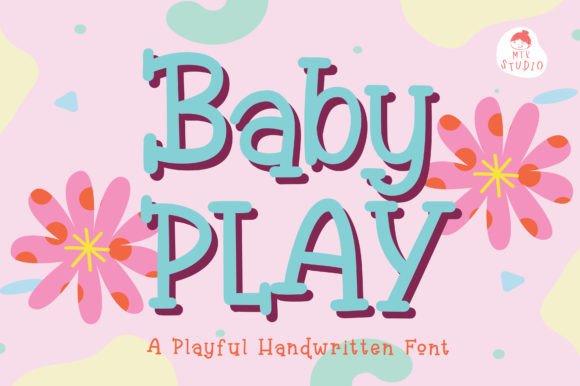
Baby Play Font: Where Friendly Design Meets Authentic Connection
Scrolling through a feed of perfectly polished, rigid geometric fonts can feel a bit like walking through a museum where you're not allowed to touch anything. Beautiful, yes. Inviting? Not always. That's precisely where a typeface like Baby Play Font enters the room and changes the energy. It's a handwritten font that doesn't try to be perfect, and that's exactly what makes it so effective. In a visual culture starving for authentic human connection, Baby Play offers a typographic handshake—friendly, approachable, and undeniably warm.
For designers, entrepreneurs, and content creators, choosing a typeface is never just about aesthetics. It's about tone, trust, and the subtle emotional signal you send before someone reads a single word. This particular font carries a distinct personality that cuts through the noise of overly polished design assets. It feels personal, and in a world of automation, personal is powerful.
The Anatomy of Friendly Design
What gives Baby Play its distinctive character? It boils down to a natural, unlabored flow. Unlike rigid geometric sans serif fonts or formal script fonts, the letterforms in Baby Play maintain a genuine human rhythm. The ascenders and descenders move organically, and the baseline carries a gentle, playful sway. It's a handwritten font that mimics real penmanship, complete with subtle inconsistencies that make it feel alive.
Within the category of modern typography, it sits comfortably as a display font—built to make a statement at larger sizes, yet clear enough to remain functional for shorter text blocks. Its sweetness never veers into cloying territory. Instead, it strikes a balance between playful and legible. This makes it a versatile creative font for projects needing a human touch without sacrificing professionalism. Think of it as the difference between a typed memo and a handwritten postcard. Baby Play captures the latter every time.
Where It Shines: Strategic Applications
While the name might suggest a narrow focus, Baby Play has surprisingly broad legs across both digital and print media. Here is where this typeface consistently delivers strong results:
- Packaging design: For small-batch products, organic skincare, artisan foods, or children's toys, the handwritten quality immediately signals "handmade" and "natural." It helps products feel crafted rather than manufactured.
- Logo design and brand identity: Small business owners in creative spaces—bakeries, illustration studios, lifestyle blogs, or nurseries—will find it an invaluable asset. It builds a consistent, memorable visual language without needing complex ornamentation.
- Social media graphics: A quote or announcement set in Baby Play reads less like a corporate ad and more like a note from a friend. It consistently drives audience engagement by lowering the perceived formality of the message.
- Editorial design: Parenting magazines, heartfelt feature pieces, and invitation suites benefit from its warmth. It pairs beautifully with clean photography and soft color palettes.
- Web design: Use it strategically in hero sections, headlines, or callout boxes. Combine it with a neutral sans serif font for body text to maintain readability on screens.
It earns its place as a premium font because of this flexibility. Whether you are designing a birth announcement or a lifestyle brand homepage, it adapts to the emotional context of the project.
Making It Work: A Practical Guide to Integration
Integrating a personality-rich typeface like Baby Play into a professional workflow requires strategy, not just instinct. Here is practical guidance on getting the most out of it:
- Invest in the proper license: Treat this as a commercial font investment. Ensure your license covers your specific use case—whether that's digital embedding, print reproduction, or merchandise. Protecting the designer's work protects your business.
- Pair it intentionally: Because Baby Play is a handwritten font with strong character, it works best as the lead vocalist. Pair it with a clean, simple sans serif font for body copy. This creates clear visual hierarchy and prevents the layout from feeling chaotic or overly casual.
- Respect scale and space: This is a display font at heart. Give it room to breathe. Use it for short headlines, pull quotes, or hero text. Avoid setting long paragraphs in it, as readability drops significantly at smaller sizes or in dense blocks. On screens, keep it at 16px or larger.
- Test across mediums: A pairing that looks perfect on a business card may need slight adjustments for a website header. Always preview your font pairing in the actual environment where it will live.
- Stay consistent: Once you commit to Baby Play as a core part of your brand identity, use it consistently across your design assets. This repetition builds brand recognition and reinforces a cohesive visual story.
Why Approachable Design Wins
There is a distinct business advantage to using a typeface that feels genuine. In crowded markets, trust is a currency. A font like Baby Play helps shape brand perception by making your message feel less corporate and more conversational. This directly impacts audience engagement. When readers feel like they are reading something written for them, rather than at them, response rates improve—whether that is a click, a purchase, or a share.
Brand recognition isn't just about logos. It is about the emotional residue left behind after an interaction. Baby Play creates positive emotional residue. It signals that a real person was behind the project, which is a powerful differentiator in an era of mass-produced content. For marketers, this translates to higher trust. For designers, it provides a reliable tool for solving the "cold brand" problem. For small business owners, it humanizes the customer experience.
Ultimately, Baby Play Font is a testament to the power of simplicity. It doesn't rely on complex ornamentation or fleeting trends. Its strength lies in its natural, friendly character and its ability to make any project feel more personal. Whether you are refining a logo design, launching a packaging design for a new product, or creating social media graphics that stop the scroll, this typeface invites the reader in. And in design, that invitation is everything.